Monday, July 13, 2015

Yellow Soybeans Need Sun, Dr. Chad Lee

Yellow Soybeans Need Sun

Chad Lee, Extension Professor and Agronomist, University of Kentucky

Numerous fields of soybeans appear yellow or bright green right now. The symptoms mimic nitrogen deficiency, but the plants are really starving for air to the roots and sun on the leaves. Everyone is thinking about applying some nitrogen to help make the plants greener. But what these plants really need is for sunshine to help partially dry the soils.
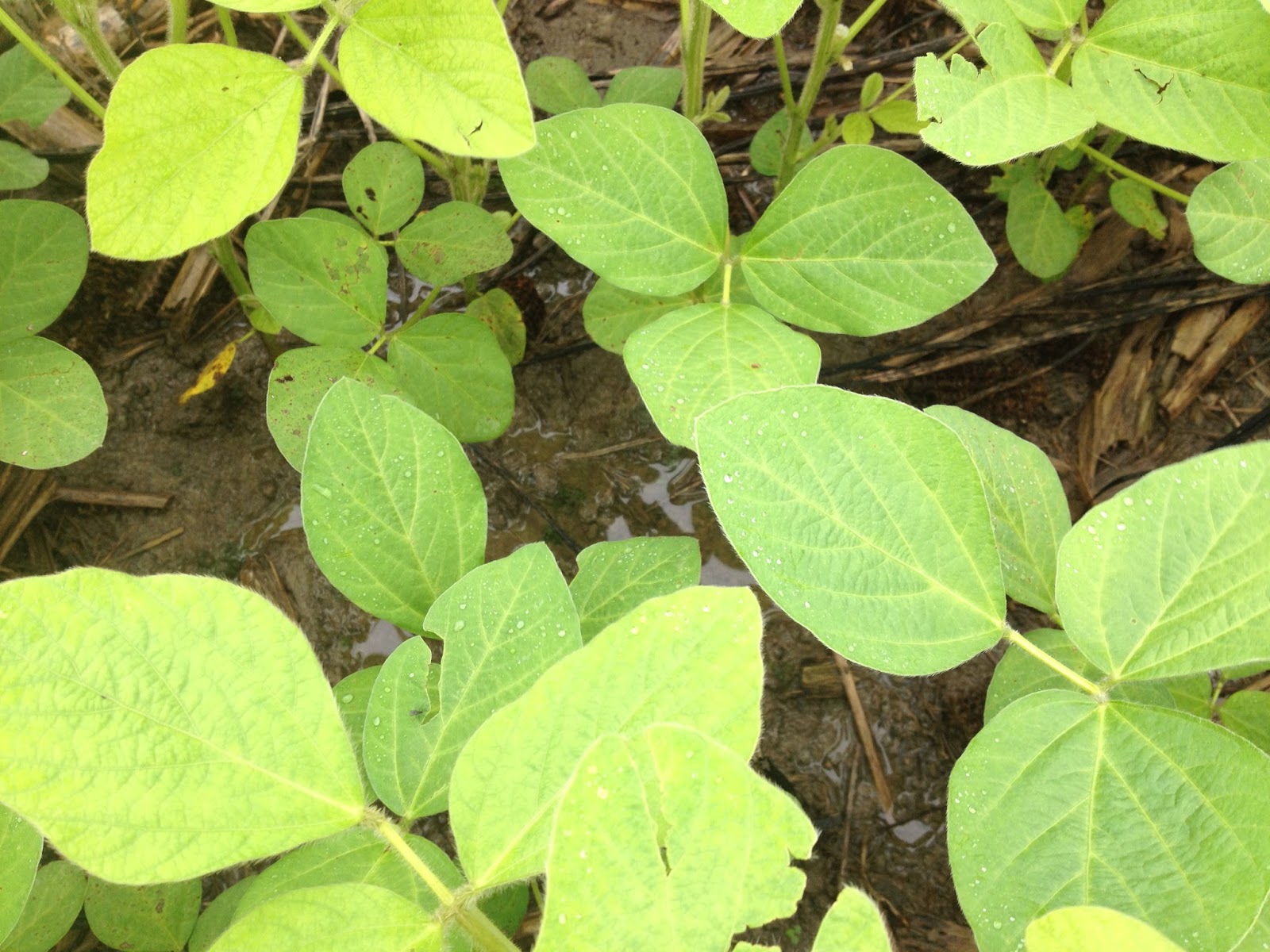


Rains have saturated our soils and pushed air out of the root zone. That lack of oxygen can lead to slowed activity of the Bradyrhizobium japonicum which leads to reduced nitrogen fixation and uptake. Extended periods of saturated soils will kill some of the roots and some of theBradyrhizobium japonicum. Both will rebound quickly once sunshine and air return to the system.

Saturated soils in the low areas
result in yellow plants.
Nodules are present but probably
dying in the saturated soils.
Cloudy skies will slow down the field-drying
process, which slows soybean recovery.
Standing water in a low area.
No room for air in this soil.
Roots from a green plant.
Viable nodules actively fixing nitrogen.
Most of the soybeans in Kentucky are flowering, so the rainfall we get now helps to build the size of plant and structures to produce pods and seeds. These yellow plants will likely lose some flowers, but even a healthy soybean plant will lose about half of its flowers. If the sun comes out soon, these plants have plenty of time to build more flowers and pods.

Rainfall and water stress during soybean seed fill is our most critical period for yield determination. The current saturated conditions likely will have very little impact on final yields. (All of these comments are based on the premise that the plants survive. Soybeans completely flooded and choking out is a completely different
Farther back in the field are
"green lines" from old tile.
Agriculture is a constant battle between
too much and too little water.
scenario.) While we need some sunshine now to help the plants recover, we need to continue getting timely rains to help this crop yield well.

Once the fields dry out enough to allow spray equipment across without causing compaction, the soybeans are probably a couple days away from becoming green again. A dose of foliar nitrogen may get one extra day of green plants, but probably will not contribute much to the overall yield of the plants.

These weather conditions are setting up quite well for disease infestations later. This is a season where good field scouting is absolutely necessary to make good decisions on disease management. Every farmer already knows that agriculture is a constant struggle between too much water and too little water. This May, June and early July are a vivid reminder.

Friday, July 10, 2015

The World Needs All Kinds of Minds, Dr. Temple Grandin

Photo from Netflix


If you have Netflix, take about 20 minutes to watch this episode of TEDTalks, where Dr. Temple Grandin discusses how the world needs all kinds of minds and how she has used her autism to her advantage in the cattle industry.  Dr. Grandin is a world-renowned livestock handling expert.  She is a professor of Animal Science at Colorado State University and designs livestock handling facilities.  She was also diagnosed with autism as a child.  HBO made a biographical film of her life staring Claire Danes (see the trailer at https://www.youtube.com/watch?v=cpkN0JdXRpM) and Time magazine names her to list of the "100 People Who Most Affect Our World".  You can also see more of her work on her YouTube Channel: https://www.youtube.com/user/TempleGrandin. 


Netflix users- click on the link below to watch her episode of TEDTalks:
http://www.netflix.com/watch/70232881?trackId=2&tctx=0%252C0%252Cf2f5063f-2470-4c8c-9699-05ec6f07e0fb-18740321

Wednesday, July 8, 2015

Time to Consider Fungicides on Soybeans

Photo from http://www.kygrains.info/
Soybeans are susceptible to a number of fungal and bacterial pathogens. These pathogens cause leaf spots and blights and are generally common in Kentucky; however, few fields in any given year are seriously damaged by foliar diseases. Crop rotation and weather that is unfavorable to disease development typically keeps foliar diseases at low levels, but this growing season has been anything but typical.

I never thought I’d complain about rain in July, but again, this growing season has not been typical.  The unusual, wet conditions that we have been dealing with are very favorable for the development and spread of fungal and bacterial pathogens.  This year may be the year to take a serious look at your spray schedule and fungicide use in soybeans.

The best chance that a fungicide treatment will result in a net economic gain for soybeans occurs when disease conditions exist which justify making an application, such as when your bean fields become an environment highly favorable to disease development.  Common soybean diseases found in Kentucky that warrant fungicide applications include Brown Spot, Frogeye Leaf Spot, Cercospora Leaf Blight, Anthracnose and Soybean Rust.  All of which thrive in wet conditions and all can cause significant yield loss.

Achieving good results with fungicides requires excellent spray coverage, regardless of the crop. Both aerial and ground applications have produced good results in corn and soybean.  Timing is also critical. Fungi have certain life stages that are vulnerable to fungicides. Similarly, plants have vulnerable stages which might require protection when the risk of target diseases is high. Either case, if a fungicide is applied too early or too late, it will not produce the desired results.  The most effective applications are usually made at the early pod (R3) growth stage.  Later applications may be needed should soybean rust ever need to be controlled.

There are a great number of other disease organisms and diseases that manifest symptoms on soybean foliage that are not mentioned above. For example, many root and stem diseases ultimately cause foliar symptoms to be expressed, but the pathogens that cause those diseases do not infect foliage directly. Rather, symptoms are usually the result of imbalances in nutrients and water in foliage. Soybean cyst nematode and stem canker are examples. In the case of soybean sudden death syndrome, foliar symptoms are the result of one or more foliar toxins that are produced by the causal fungus as it grows in diseased root tissue.

Virus diseases, such as soybean mosaic and bean pod mottle, reproduce systemically and, thus, can readily be found throughout infected foliage with the aid of an electron microscope. The principal symptoms of virus diseases are expressed in crop foliage.

For more information on Integrated Pest Management in soybeans and other crops or for a copy of the University of Kentucky’s Soybean Fungicide Efficiency Table, contact the McLean County Cooperative Extension Office at (270)273-3690. Educational programs of the University of Kentucky Cooperative Extension Service serve all people regardless of race, color, age, sex, religion, disability or national origin.


Upcoming Events
July 17th&18th Ag Festival
July 21st         Estate Planning Workshop, 6pm
July 23rd         Farm Succession Seminar, Riverpark Center
July 28th&30th       Customer Appreciation Days at Farmers’ Market
July 30th         UK Corn, Soybean & Tobacco Field Day, Princeton
Aug 4th County Extension Council and District Board Meeting
Aug 7th Tri-County Grain Sorghum Field Day
Aug 13th         CPH Sale
Aug 14th McLean Co. Beef Field Day

Wednesday, June 24, 2015

How Will Avian Influenza Affect Us?

Photo from www.incnow.com
I am sure that by now almost all of you have heard or read the words “Avian Influenza” or “Bird Flu”.  While we have been extremely fortunate in our area to not have any cases (please knock on any wood that you have close by), we still cannot rest easy.  Even if you are a poultry producer or not, AI will affect you in some way, shape or form, and we all need to be proactive.

Avian Influenza (AI) has hit the American egg and turkey industries hard in the last few months with over 45 million chickens and turkeys killed. Several backyard flocks have been affected, and consumer pocket books will likely be feeling it soon.

The main effect will be on the price of eggs and turkeys.  AI has devastated the egg and turkey flocks and it will take many months for the infected facilities to come back into full production. The result may be a shortage of eggs and turkeys resulting in a major rise in the price of both. To date, meat chicken flocks have not been affected and no poultry (chicken and turkey) operation has been affected in McLean County.

UK Extension Associate for Poultry Dr. Jacquie Jacob explains in a recent article that Avian Influenza is caused by a very tricky virus and there are many different types known as strains. The different viruses are identified by their surface projections referred to as H and N. There are 16 different types of H’s and 9 types of N’s, making for a lot of possible combinations. To complicate things, even with the same H and N designation, the viruses can be classified as low path (LPAI) or high path (HPAI). The designation of LPAI or HPAI refers to the ability of the virus to kill birds. With the LPAI viruses the number of birds that die can be very low. In the case of HPAI types, however, mortality can reach 100% within a matter of days. The problem with the LPAI viruses is that they can easily change and become HPAI. The types of viruses of most concern are the H5’s and H7’s. We are currently dealing with H5N2, H5N8 and H5N1 HPAI strains. The current HPAI outbreak was first detected in western Canada and later detected in northern Washington State in December of 2014. Since then it has been detected in 15 states and has affected 212 farms. Iowa and Minnesota turkey and egg farms have been hit the hardest.

The Avian Influenza virus is believed to have been brought in by migratory waterfowl (ducks and geese). Waterfowl can carry the virus without getting sick. They shed the virus in their manure, infecting other birds. The HPAI virus has been detected in three of the four North American Flyways – Pacific, Central and Mississippi. At the moment there is no effective vaccine available for HPAI.

Anyone keeping poultry flocks, especially those with waterfowl, needs to be concerned about HPAI. While the majority of the American flocks affected have come from commercial operations, several backyard flocks have been infected as well. Most of these had mixed flocks which included ducks or geese.

To protect your flock: don’t attract wild birds by putting out bird feeders near your flocks; don’t introduce adult birds purchased from swap meets or flea markets; restrict access to your flocks; keep your work cloths and equipment clean; don’t borrow lawn and garden equipment tools or poultry supplies from other bird owners; and be on the alert for warning signs of Avian Influenza. The warning signs of AI in birds include sneezing, coughing, nasal discharge, watery or green diarrhea, and purple discoloration of the combs, wattles and legs.

When the migratory waterfowl begin in the fall there is a greater chance that Avian Influenza will be detected along all four flyways. Small flock owners should discourage migratory birds from roosting on their farms. Eliminate feed sources and discourage birds through sound devices. This fall will require producers to be very diligent about hunting and being in the woods so as to not track back the virus to their farms.

Early detection and reporting are very important ways to stop the spread of Bird Flu. If you see unusual symptoms or if you have a high number of deaths in your flock, contact your local veterinarian or the state veterinarian at 502-782-5920. You may also call the U.S. Department of Agriculture’s toll-free hotline at 866-536-7593.

To report any sick or dead waterfowl in Kentucky, call the Kentucky Department of Fish and Wildlife at 800-858-1549. For other types of wild birds, only call to report deaths of five or more birds.

To date there is no evidence that the current HPAI viruses that are infecting poultry flocks in the U.S. can infect humans. While it is not believed that the virus is transmitted through poultry meat and eggs, no products from infected flocks are entering the human food chain.

We are currently planning an educational program on AI prevention in home flocks (especially during fall migration) and ways to save while egg prices are high.  This program will take place sometime in August so be on the lookout for more details to come.

For more information about Avian Influenza (Bird Flu), contact the McLean County Cooperative Extension Service at (270)273-3690.  Educational programs of the Kentucky Cooperative Extension Service serve all people regardless of race, color, age, sex, religion, disability or national origin.


June 25th         Kid’s Day at Farmers’ Market
June 27th         Hopkins County Ag Pride Day
July 17th&18th Ag Festival
July 21st         Estate Planning Workshop, 6pm
July 23rd         Farm Succession Seminar, Riverpark Center
Aug 14th McLean Co. Beef Field Day

Wednesday, June 17, 2015

Set Disc Mowers High to Prolong Grass Hay Stands

Photo from deere.com
Over the past year I have had producers come into the office with complaints about orchardgrass stands.  The majority of the time I felt like it was due to soil fertility.  While reading the June edition of UK’s Forage News, I read that while soil fertility does play a large role in stands, UK Extension Forage Specialists are now making a new recommendation for producers concerning mowing heights.

Dr. Garry Lacefield and others conducted a survey of forage specialists across the U.S. a few years ago on the reasons orchardgrass hay fields seem to be thinning out in recent years. Survey respondents identified lower fertility, severe weather conditions, insects, and diseases as factors contributing to stand loss, but they felt that the number one reason for shorter stand life was low cutting heights. And low cutting heights were mainly attributable to disc mowers.

Disc mowers are great hay cutting tools, with their ease of operation, speed of harvest, and ability to easily harvest thick stands. These mowers allow producers to easily harvest at 1 to 2 inches. Low cutting heights like this are fine for alfalfa since it regrows from energy stored below ground in its large taproot, but can be disastrous for grasses like orchardgrass. Orchardgrass has a more upright growth habit and low cutting removes all the leaves needed for photosynthesis and the base of tillers (stems) where carbohydrates are stored for regrowth.

An Asbury University student, Leah Saylor, conducted a research experiment on orchardgrass cutting height at UK 4 years ago. Leah found that just one season with low cutting heights significantly reduced stand longevity and increased weed infestation, regardless of the addition of fertilizer treatments. The results show that the recommended cutting height of 3 to 4 inches for orchardgrass and similar grasses is essential to maintain thick, weed free stands. Most disc mower manufacturers sell skid shoes to insure higher cutting heights. These are well worth the price, especially if they help in producing a better stand of grass hay.

For more information about forage production, contact the McLean County Cooperative Extension Office at (270)273-3690.  Educational programs of the Kentucky Cooperative Extension Service serve all people regardless of race, color, age, sex, religion, disability or national origin.


Upcoming Ag Events
June 23rd                  UK Weed Science Field Day, Princeton
June 25th                  Kid’s Day at Farmers’ Market
June 27th                  Hopkins County Ag Pride Day
July 8th          McLean Co. Beef Field Day
July 17th&18th Ag Festival

Tuesday, June 16, 2015

Vole Control.....this one is for you Dad

Photo from http://www.agry.purdue.edu/
Following last week's post about mole control, I got a text from my Dad, "You need to post how to get rid of voles".  So Dad, this one is for you and thank you for letting me know that at least one person out there reads my blog post!

Voles are small, chunky, ground-dwelling rodents. Mature voles are 5 to 7 inches long and have stocky bodies, short legs, and short tails. Adults are chestnut-brown mixed with black, and their underparts are dark gray. The underfur is generally dense and covered with thicker, longer guard hairs. Their feet are brownish, and the thin hair that covers their tails is dark on the upper surface, gradually changing to a lighter gray beneath. They have small black eyes, and their ears are furred and do not project much above the hair. The young are uniformly gray.

Voles have other common names, including meadow mice, ground moles, field mice, and meadow moles. The use of these terms can cause confusion when identifying rodents. It is important that small mammals be identified correctly before starting control activities, since materials and methods effective against one species may not be useful on another.

Voles are frequently mistaken for moles, shrews, and mice. Moles have greatly enlarged front feet, with prominent digging claws. Moles also have no external ears and very small eyes. Shrews are smaller than voles, and have long, pointed snouts and pointed front teeth, with their eyes and ears nearly hidden in their fur. Voles have rounded, blunt snouts, and their front teeth are chisel-shaped. Their eyes and ears are readily apparent. The distinction between voles and mice is less obvious. The best way to distinguish them is by tail length. Mice have long tails that extend nearly half their body length, whereas voles have short tails.

The three vole species that cause damage Kentucky are pine voles (Microtus pinetorum), prairie voles (Microtus ochrogaster), and meadow voles (Microtus pennsylvanicus). Identification of individual species is essential because pine vole damage occurs below ground.

Voles eat a variety of grasses and broad-leaved weeds. They will also eat seeds, tubers, bulbs, and rhizomes. Prairie and meadow voles feed on tree bark primarily during the fail and winter. However, pine voles characteristically attack trees of all sizes during all seasons. Most pine vole damage occurs below ground where the animals feed on rootlets and the bark of larger roots.

Voles do not hibernate and are active all year long. They are most active during the day. Areas of activity are small (1/4 acre) and depend on population number, food supply, habitat, and season. A typical vole habitat consists of heavy, dense ground cover where the animals construct many burrows, tunnels, and runways. A single burrow system may contain several adults and young.

Voles breed from January through October in Kentucky and can produce an entirely new generation within about 60 days. Vole numbers fluctuate from year to year; under favorable conditions, populations can increase rapidly.

Although voles have a high reproductive rate, they are also a mainstay in the diet of hawks, owls, foxes, coyotes, and other meat-eating animals. In addition, the lifespan of a vole is short, ranging from 2 to 16 months. More than 80% of young voles die in their first month of life.

The best approach to managing vole damage is to use an integrated system with a variety of techniques. Not all techniques work in every situation, and orchard owners must be willing to use different approaches for their individual problem. Often a combination of techniques produces the best results. The various prevention and control techniques may be grouped as (1) biological, (2)mechanical, or (3) chemical. Each technique has advantages and disadvantages depending on management objectives, expense, location, and situation.

The three types of biological control are habitat modification, population reduction through hunting or trapping, and installation of raptor perches.  Habitat modification is particularly effective in deterring voles. Dense, heavy vegetative cover, mulch, and weeds provide optimum habitat for voles  by providing food and protection from predators. If you remove this food and cover source, the area will provide less suitable habitat.

Soil tillage is particularly effective because it eliminates any cover, destroys existing burrow systems, and kills a percentage of the vole population.  This method of control is one of the most effective, long-term solutions in reducing vole damage. It has several advantages over other techniques because it is economical, does not place harmful chemicals into the environment, and is a long-term solution to the problem, not a quick fix.

According to Penn State Extension Research, repellents containing thiram (a fungicide) or capsaicin (the ingredient that makes chili peppers hot) are registered for vole control. Little data is available on the effectiveness of repellents to deter vole damage. Therefore, repellents should not be used as the sole method of vole control.

Thiram-based repellents are labeled for use on tree seedlings, shrubs, ornamental plantings, nursery stock, and fruit trees. Most labels only allow thiram to be used on fruit trees during the dormant season. Capsaicin-based products are labeled for use on ornamental trees, fruit and nut trees, fruit bushes and vines, nursery stock, shrubs, and lawns. Capsaicin should be applied only before the fruit sets or after the harvest. Capsaicin is registered for use on vegetable plants and agricultural crops only before edible portions and/or heads begin to form.

To prevent a feeding pattern from developing, repellents should be applied before damage becomes significant or, in the case of monitored populations, before damage occurs. They must be reapplied frequently after a rain, heavy dew, or new plant growth. Always follow label directions for the repellent being used. Never apply repellents to any portion of a plant likely to be eaten by humans or livestock unless the label permits it.

Zinc phosphide and anticoagulant baits are registered for use on voles. These toxicants are restricted-use pesticides. Any person using these pesticides must be a certified pesticide applicator or work directly under the supervision of a certified applicator.

Zinc phosphide is the toxicant most commonly used to control voles. It is a single-dose toxicant available in pellets, as a concentrate, and as a grain-bait formulation. Zinc phosphide baits generally are placed directly into runways and burrow openings at rates of 2 pounds per acre. Although prebaiting (application of similar nontreated bait prior to applying toxic bait) is usually not needed to obtain good control, it may be required in some situations, such as when a population has been baited several times and bait shyness has developed. Zinc phosphide baits are potentially hazardous to ground-feeding birds, especially waterfowl. Minimize risks to nontarget wildlife by placing bait directly in burrow openings or in runways and tunnels under cover boards.

Anticoagulant baits also are effective for controlling voles. Anticoagulants are slow-acting toxicants in pellet form that take effect in 5 to 15 days. Multiple feedings are needed for most anticoagulants to be effective. Recommended application rates for anticoagulant toxicants are 10 pounds per acre when placing pellets directly into runways. If vole problems persist, reapply the anticoagulants 30 to 60 days later.

Because of the hazard to nontarget wildlife, it is recommended that baits be placed in bait containers. Water repellent paper tubes with the bait glued to the inside surface make effective, disposable bait containers. Tube size should be about 5 inches long and 1½ inches in diameter. Bait containers protect bait from moisture and reduce the likelihood that nontarget animals and small children will consume the bait. Bait stations also can be made from discarded beverage cans. Enlarge the opening in the end of the can so that it is about 1½ inches in diameter and place a dent in the side of the can. Put the bait in the can and place the can, dented side down, in the area to be protected. Mark the bait containers with flags or stakes so they can be relocated. Another type of bait station that has been successful is made from an automobile tire split longitudinally. Tires are placed with the hollow side down, and the bait is placed in a small cup under the tire. The tire halves are then distributed throughout the area at a rate of one per tree or one every 10 yards. Discontinue use if nontarget animals are coming into contact with bait.

Woodland voles are not as active above ground, so when targeting these types of voles, place the bait directly in runways and burrow openings under infested trees at two to four locations. If runways and burrows cannot be found, roofing shingles, boards, or other objects may be placed on the ground to encourage woodland voles to build tunnels or nests under them. Bait can then be placed under these shelters once woodland voles are using them.

Timing also influences the success of control programs. Wet weather reduces the effectiveness of toxicants. Therefore, try to place the bait when the weather is likely to be fair and dry for at least three days. Baits are most effective when naturally occurring foods are limited. Late fall is an important time to place bait for voles because this practice helps reduce populations before the onset of winter, when vole damage is most severe and snow cover precludes the use of toxicants. When the vole population is high during early spring, baits should be applied before the breeding season and before the renewed growth of ground cover reduces the chance that voles will accept bait.

Toxicants are poisonous to all forms of animal life. Nontarget animals can be injured or killed by eating toxicants directly or by eating voles that are killed by toxicants. Therefore, do not place bait in piles or on bare soil. Do not use baits where there is a chance of harming humans, domestic animals, or desirable wildlife. It is unlawful to use pesticides in a manner inconsistent with their labeling.

And Dad, if all else fails you need to get a rat terrier!  I didn't even realize that we had voles around our place until we got Buddy a couple of months ago.  That dog is nice enough to leave dead voles in the driveway all the time so he has proven to be very effective in the fight against voles.  I'll even get you one for Father's Day if the voles are that bad at your place!


Sources:
http://www2.ca.uky.edu/agc/pubs/for/for43/for43.htm

http://extension.psu.edu/natural-resources/wildlife/wildlife-nuisance-and-damage/small-mammals/wildlife-damage-control-9-voles